June 21, 2026 ⋅ Averta Team ⋅ 7 minute read
What is an MCP Gateway? Governing Enterprise AI
An MCP gateway sits between AI agents and MCP servers to enforce scoped access, policy, and audit. What an MCP gateway is, how it works, and when you need one.
Most teams adopt the Model Context Protocol one server at a time. You connect an agent to GitHub, then Notion, then a database, then a payments tool. Each connection is quick on its own. A few months later you have dozens of agents reaching dozens of MCP servers, every connection carries its own token, and nobody can answer a simple question: which agent can do what, and who approved it.
That gap is what an MCP gateway closes. As agents move from demos into production, the gateway has become the standard way to put a single point of control between the agents and everything they can reach.
What is an MCP gateway?
An MCP gateway is a governed proxy that sits between your AI agents and the MCP servers they connect to. Every tool call passes through it, so the gateway can enforce per-agent permissions, apply policy to each action, hold credentials centrally, and record an audit trail, instead of letting each agent talk to each server directly.
The Model Context Protocol, introduced by Anthropic and now governed under the Linux Foundation's Agentic AI Foundation, standardizes how agents discover and use tools, data, and prompts. It solves the integration problem: one protocol instead of bespoke connectors for every app. What it does not solve is the control problem. MCP defines how an agent connects to a server, not which agents should be allowed to, what they can do once connected, or how you prove what happened afterward. An MCP gateway is the layer that adds those controls.
Why MCP gateways exist
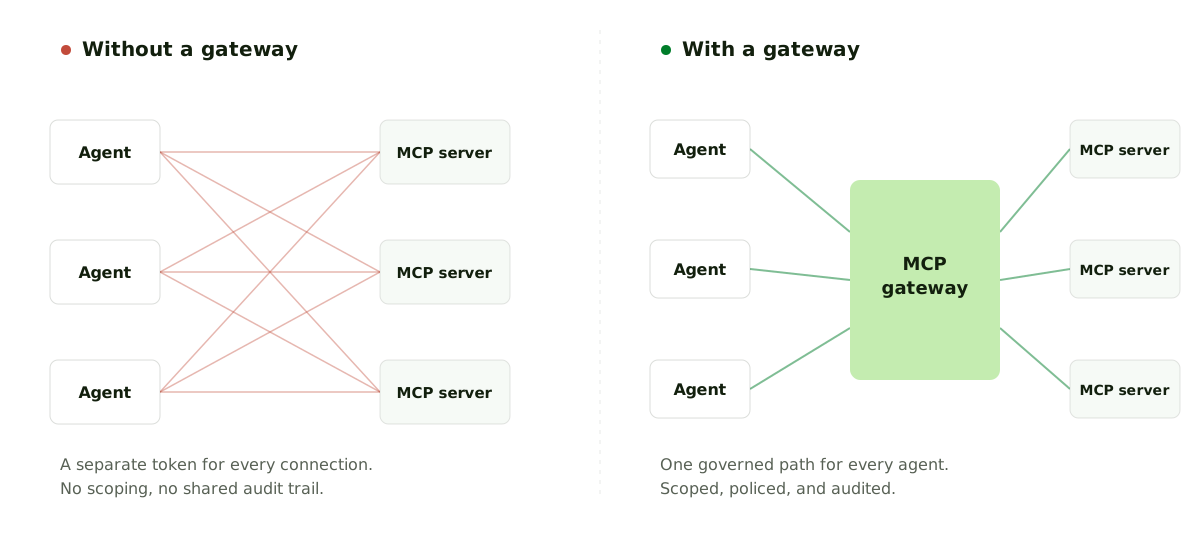
Connecting an agent directly to an MCP server works fine for one agent and one server. It stops working as the numbers grow, for three reasons.
Token sprawl. Each direct connection needs its own credential. Spread across many agents and servers, those tokens end up scattered through config files and environments, hard to rotate and harder to revoke. A single leaked token can grant broad access with no easy way to shut it off.
No scoping. An MCP server usually exposes everything the connecting credential can reach. An agent that only needs to read issues often receives the same token that can also close them, edit them, or delete them. Without a layer in between, least privilege is a hope, not a control.
No visibility. When an agent calls a tool directly, there is no shared record of the request, the decision, or the result. If something goes wrong, you cannot reconstruct what the agent did, and you have nothing to hand an auditor. As one widely shared Anthropic talk on agent architecture put it, gateways end up being most of what production agent systems need.
A gateway exists to turn those three problems into one managed surface.
How an MCP gateway works
The mechanics are simple. Instead of pointing each agent at each MCP server, you point every agent at the gateway, and the gateway connects to the servers on their behalf.
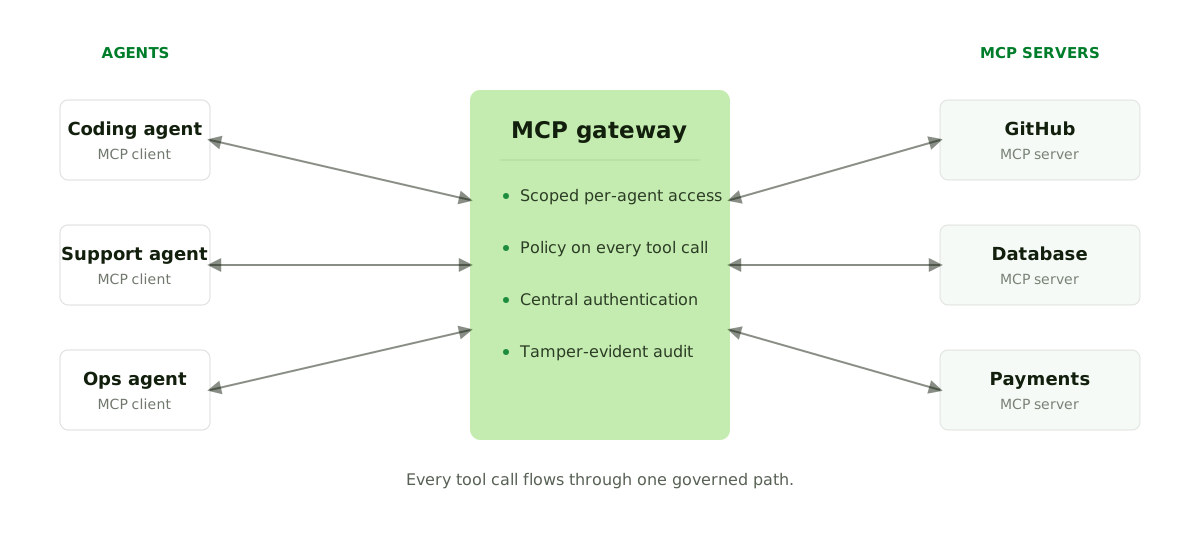
Because every request now flows through one place, the gateway can do four things on each tool call:
- Authenticate the agent and confirm which identity is making the request.
- Check the request against policy for that specific agent and tool.
- Forward, hold for approval, or block the call based on the result.
- Record the request, the decision, and the outcome to an audit log.
The agent experience does not change. It still speaks MCP and calls tools the same way. The difference is that the gateway, not the raw server, decides what actually executes.
What an MCP gateway does
The strongest gateways converge on the same core set of capabilities. When you evaluate one, these are what to look for.
Scoped, per-agent permissions
Each agent should reach only the servers and tools its job requires, with read and write separated. A support agent might get read access to a knowledge base and nothing else, while a different agent gets scoped write access under tighter rules. The gateway issues those permissions per agent instead of relying on one shared token. Scoping each agent to only what its job requires is the heart of AI agent access control.
Policy on every tool call
Beyond who can connect, the gateway decides what each action is allowed to do at the moment it happens. A read can run automatically while a destructive action, like deleting records or moving money, is held for approval or blocked. This runtime check, the same allow, escalate, or block model behind a tool policies framework, is what separates a gateway from a simple proxy.
Centralized authentication
Credentials live at the gateway rather than in each agent. That ends token sprawl, makes rotation a single operation, and gives you one place to revoke access instantly if an agent or key is compromised.
Audit and observability
Every call produces a tamper-evident record of what was requested, what policy decided, and what happened. That gives security teams real-time audit and observability and gives auditors the evidence they expect, mapped to the controls frameworks like SOC 2, ISO 27001, and DORA require.
A single managed surface
Hosting and connection management move to the gateway, so clients like Claude, Cursor, and ChatGPT reach approved servers through one endpoint instead of each team running and securing servers on their own machines.
Do you need an MCP gateway?
Not every setup needs one. A single developer wiring one agent to one server for a prototype does not. The case for a gateway grows with scale and stakes. You likely need one when several of these are true:
- Multiple agents connect to multiple MCP servers.
- Those servers touch sensitive data, customer records, or systems that can take real-world actions.
- You need to enforce least privilege per agent, not one broad token for all.
- A security or platform team has to prove what agents did, for compliance or incident response.
- You want to add, rotate, or revoke access without editing config across every agent.
If you are deploying agents in an enterprise, the question is usually not whether to govern MCP access, but where. A gateway is the place that scales. The risks it manages, from over-broad tokens to prompt injection that turns a poisoned tool result into an unwanted action, are covered in more depth in our guide to MCP security.
The MCP gateway landscape
MCP gateways come in a few shapes. Some are open-source projects you run and secure yourself. Some are features bundled into broader API or AI gateways. Others are dedicated, governance-first platforms built for enterprise teams that need scoped access, policy, and audit out of the box. They differ most in how much governance they enforce by default, how they handle authentication, and whether the audit trail is built for compliance or just for debugging.
The right choice depends on how many agents and servers you run, how sensitive the systems behind them are, and how much you need to prove after the fact.
How Averta approaches the MCP gateway
The Averta MCP Gateway is built for the enterprise end of that spectrum. It gives every agent scoped, per-agent permissions to MCP servers, applies allow, escalate, or block policy on each tool call, holds authentication centrally so there is no token sprawl, and records a tamper-evident audit of every action. It is one governed proxy in front of every MCP connection your agents make.
If you are moving AI agents into production and need to govern what they can reach, book a demo and we will show you how it works against your own setup.