June 22, 2026 ⋅ Averta Team ⋅ 11 minute read
AI Agent Access Control: How to Govern Agent Permissions
AI agent access control governs what autonomous agents can read, reach, and do. The identity, authorization, and runtime controls enterprises need.
An AI agent is not a user, and it is not an application. It logs in like a service, reasons like a person, and acts faster than either. When you give one a credential, you are not granting access to a predictable program that does the same thing every time. You are granting access to a system that decides, at runtime, what to do with that access based on text it reads along the way. That is what makes AI agent access control its own problem, distinct from the identity and access management built for humans and microservices over the last two decades.
The stakes are concrete. An agent with a broad token, pointed at the wrong instruction, becomes a privilege-escalation event: it can read data it should never touch, call a tool it was never meant to use, or take an irreversible action on behalf of a user who never asked for it. The discipline that prevents this is access control, redesigned for a principal that is neither human nor static.
What is AI agent access control?
AI agent access control is the set of identity, authorization, and runtime controls that determine what an autonomous AI agent is allowed to read, reach, and do, on every action it takes. It governs which systems an agent can connect to, which tools and operations it can invoke once connected, and which actions require a human in the loop, and it produces an audit trail of every decision.
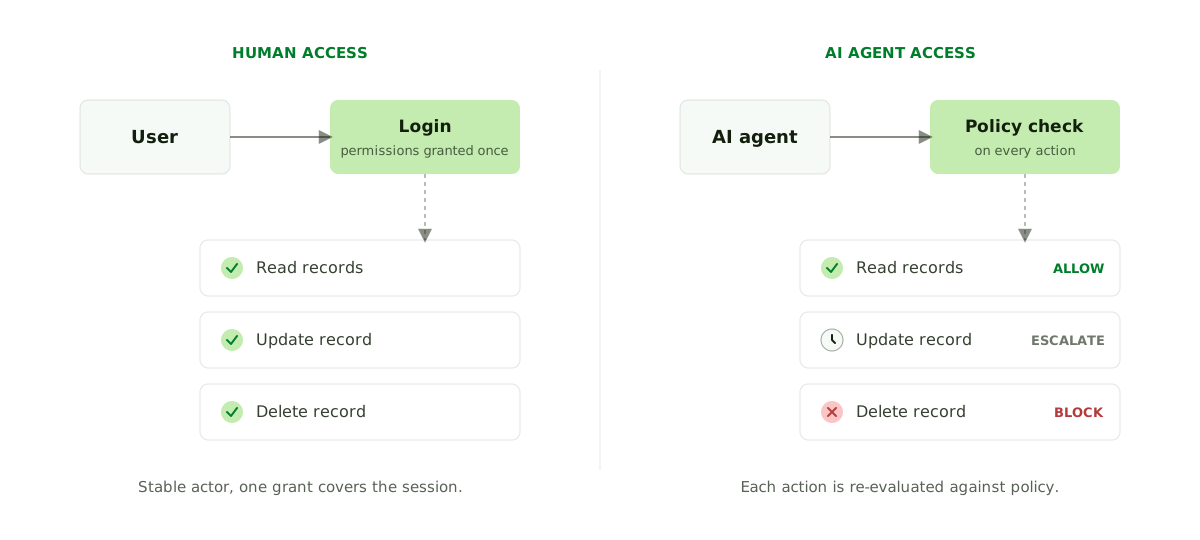
Traditional access control answers one question at login: who are you, and what are you allowed to do? That model assumes the actor is stable. A human's intent does not change mid-session because they read a web page; a microservice does not suddenly decide to call a different API because a tool description told it to. AI agents break both assumptions. Their behavior is driven by their context, and their context is full of untrusted text. So access control for agents cannot be a one-time grant at the door. It has to be a continuous check on every action, informed by who the agent is, what it is trying to do, and whether that specific action is allowed right now.
Why AI agents break traditional access control
Four properties of agentic systems make human-era access control insufficient on its own.
Agents are non-deterministic. The same agent, given the same goal, can take different paths on different runs. You cannot enumerate in advance every action it will take, so you cannot rely on a fixed allow-list of API calls the way you would for a deterministic service. Authorization has to evaluate actions as they happen, not just at deployment.
Agents act on behalf of others. An agent usually operates with delegated authority, carrying out work for a user or a team. That creates a classic confused-deputy problem: the agent holds permissions, untrusted input tells it what to do, and the gap between "what the user authorized" and "what the agent was tricked into doing" is where compromise lives. A successful prompt injection does not need to steal a credential when it can simply redirect an agent that already has one.
Agents discover tools dynamically. Through the Model Context Protocol and similar standards, agents bind to new tools and data sources at runtime. The set of things an agent can reach is no longer fixed at build time. Access control has to account for capabilities that appear after deployment, which is why static, design-time permissioning falls short and dynamic authorization for AI agents has become its own requirement.
Agents persist and scale. Memory, session state, and long-running tasks mean a compromise in one session can survive into later ones. And agents act at machine speed across many sessions at once, so a permission that is slightly too broad is not a small mistake. It is a small mistake multiplied by every action the agent will ever take.
The building blocks of AI agent access control
A complete program rests on five layers. Each answers a different question, and a gap in any one undermines the others.
Agent identity
Every agent needs to be a first-class principal with its own identity, not a shared service account borrowed from a human or a team. When ten agents share one credential, you lose the ability to say which agent did what, to scope permissions to a single agent's job, or to revoke one agent without breaking the rest. Distinct agent identity is the foundation everything else builds on: you cannot enforce least privilege or produce a meaningful audit trail for an actor you cannot name. This is the same reason the industry is converging on per-agent identity rather than treating agents as anonymous extensions of the user who launched them.
Authentication and credential containment
Once an agent has an identity, it has to prove it, and the credentials it uses to reach downstream systems have to be contained. The failure mode here is token sprawl: every direct agent-to-system connection needs its own secret, and those secrets end up scattered across config files and environments, impossible to rotate and harder to revoke. Containing credentials in one place, so individual agents never hold the downstream keys, turns a sprawling secret-management problem into a single managed surface. The emerging standard for this is OAuth 2.1-based authorization, where agents obtain short-lived, scoped tokens rather than holding long-lived broad ones.
Authorization: least privilege for agents
Authentication confirms who the agent is. Authorization decides what it can do. This is where role-based access control (RBAC) and attribute-based access control (ABAC) come in, applied to agents instead of people. A support agent might get read access to a knowledge base and nothing else; a different agent gets scoped write access to a single system under tighter rules. The principle is least privilege: each agent reaches only the servers, tools, and operations its job requires, with read and write separated, rather than inheriting one broad token that can do everything the underlying credential can.
Runtime policy on every action
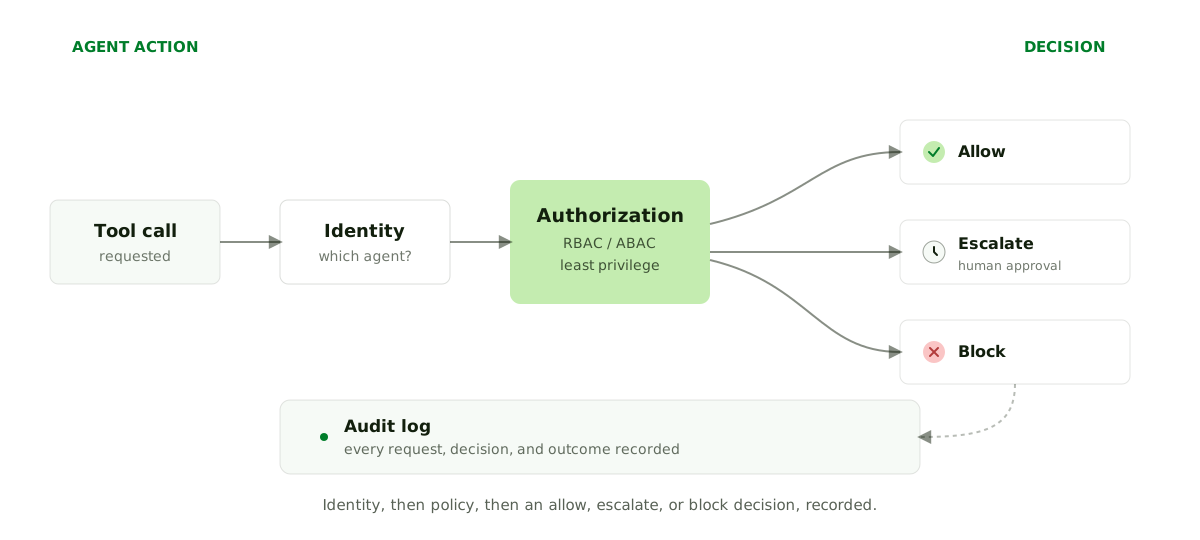
Static permissions decide what an agent can connect to. Runtime policy decides what each individual action is allowed to do at the moment it happens. A read can run automatically while a destructive operation, deleting records or moving money, is held for approval or blocked. This allow, escalate, or block model, the core of a tool policies framework, is what makes access control dynamic instead of a one-time grant. It is also where human-in-the-loop approval lives: the highest-risk actions pause for a person rather than executing on the agent's judgment alone.
Audit and observability
Every access decision should produce a record: what the agent requested, what policy decided, and what happened. Without it, you cannot reconstruct an incident, prove least privilege to an auditor, or tell the difference between an agent doing its job and an agent that was redirected. Tamper-evident audit and observability turns access control from a set of rules into evidence, which is what compliance frameworks and incident response both ultimately require.
Access control patterns for AI agents
The building blocks come together in a few recurring patterns.
Per-agent scoped permissions. Instead of one shared credential, each agent gets its own scoped grant, narrowed to the specific tools and operations it needs. This is the practical expression of least privilege, and it is only possible once each agent has a distinct identity.
Just-in-time access. Rather than holding standing permissions, an agent requests elevated access for a specific task and loses it when the task ends. This shrinks the window in which an over-broad permission can be abused, and it maps naturally onto the short-lived-token model.
On-behalf-of versus agent identity. Some actions should carry the user's identity and permissions; others should run as the agent's own constrained identity. Deciding which is which, and never letting an agent silently inherit the full authority of the user who launched it, is one of the central design choices in agent access control.
The gateway pattern. As the number of agents and systems grows, enforcing all of this connection by connection stops scaling. The common answer is to route every agent through a single governed chokepoint that holds identity, authorization, credentials, and audit in one place. This is the role an MCP gateway plays: every tool call passes through it, so scoped access, runtime policy, and audit are enforced consistently instead of reimplemented for each integration.
Common mistakes
A few patterns show up repeatedly when teams first put agents into production.
- Shared service accounts. Multiple agents behind one credential, which destroys per-agent scoping and audit before you start.
- Standing broad permissions. Granting an agent everything it might ever need, instead of scoping to what this agent needs now, because narrow permissions feel like more work.
- Design-time-only authorization. Permissioning what the agent can connect to but never checking what each action does at runtime, which leaves destructive operations unguarded.
- No human-in-the-loop tier. Treating every action as equally safe to automate, with no class of high-stakes operations that pauses for approval.
- Access control without audit. Enforcing policy but not recording decisions, which leaves you unable to prove anything after the fact.
Each of these is a place where an agent that has been redirected, whether by injection, by a poisoned tool description, or simply by its own misjudgment, turns a small gap into a real-world action. Access control is one pillar of AI agent governance and one layer of a broader agentic AI security program, and it works best alongside the input classification and MCP security controls that sit around it.
How Averta approaches AI agent access control
Averta puts the five layers behind a single governed surface. The Averta MCP Gateway gives every agent its own scoped, per-agent permissions and holds authentication centrally, so individual agents never carry downstream credentials and there is no token sprawl. On top of that, a tool policies framework applies allow, escalate, or block decisions to every tool call at runtime, with human-in-the-loop approval for the highest-risk actions, while the classification engine inspects the inputs that drive an agent's behavior before they reach the model. Every decision is written to a tamper-evident audit trail. The result is access control that is scoped at the door, enforced on every action, and provable after the fact.
If you are moving AI agents into production and need to govern what they can reach, book a demo and we will show you how it works against your own agents.
Frequently asked questions
What is the difference between authentication and authorization for AI agents?
Authentication confirms which agent is making a request; authorization decides what that agent is allowed to do. Agents need both: a distinct identity they can prove, and per-agent permissions that scope what they can reach once that identity is established.
How is AI agent access control different from human IAM?
Human IAM grants permissions once at login to a stable actor whose intent does not change mid-session. Agents are non-deterministic, act on delegated authority, and discover new tools at runtime, so their access has to be re-evaluated on every action rather than granted once at the door.
What is RBAC for AI agents?
Role-based access control for AI agents assigns each agent a role that scopes which tools and operations it can use, the same way RBAC scopes human users. It is one way to implement least privilege for agents, often combined with attribute-based rules and runtime policy for higher-risk actions.
Do AI agents need their own identity?
Yes. Giving each agent a distinct identity, rather than a shared service account, is what makes per-agent scoping, selective revocation, and meaningful audit possible. Without it, you cannot say which agent did what or limit one agent without affecting the others.