June 22, 2026 ⋅ Averta Team ⋅ 10 minute read
AI Agent Governance: A Framework for the Enterprise
AI agent governance keeps the AI agents you deploy accountable: the discovery, identity, policy, and oversight autonomous agents need. A practical framework.
Most organizations did not decide to deploy a fleet of AI agents. They deployed one, then a team built another, then a SaaS vendor shipped a third inside a product the company already used. A year later there are dozens of autonomous agents acting across the business, each holding credentials and taking actions, and no single person can say how many there are, what they can do, or who signed off. That gap between how fast agents proliferate and how slowly oversight catches up is the problem AI agent governance exists to solve.
Governance built for models and applications does not reach this far. A model card describes a model; it says nothing about an agent that uses that model to send emails, move money, or modify production data. AI agent governance is the discipline that extends control, accountability, and oversight to the autonomous actors themselves.
What is AI agent governance?
AI agent governance is the set of policies, processes, and controls an organization uses to maintain visibility, control, and accountability over the AI agents it deploys, across their entire lifecycle. It covers knowing which agents exist, what each one is allowed to do, how their actions are enforced and monitored at runtime, and how the organization proves all of it to auditors and regulators.
The distinction worth holding onto is between AI governance and AI agent governance. AI governance is the broad practice of managing AI responsibly: model risk, bias, data provenance, and the policies that surround how AI is built and used. AI agent governance is the subset focused on autonomous agents that take actions. It inherits the concerns of AI governance and adds the ones that only appear when software stops generating text and starts doing things: which agent acted, under whose authority, with what permissions, and whether anyone could stop it.
Why AI agent governance is different
Three shifts make agent governance its own discipline rather than a footnote to existing AI or IT governance.
Agents act, and they act autonomously. A traditional application does what it was programmed to do. An agent decides what to do at runtime, based on context it reads along the way. Governance cannot rest on reviewing source code or a fixed list of API calls, because the agent's behavior is not fixed. It has to govern the actions as they happen.
Agents proliferate faster than oversight. Agent sprawl is the defining operational challenge. Agents are easy to spin up, often created outside central IT, and frequently embedded inside third-party tools. The result is a population of shadow agents that no inventory captures, holding access that no one is tracking. You cannot govern what you cannot see, so discovery is the first governance problem, not an afterthought.
Agents carry delegated authority. An agent usually operates on behalf of a user or team, holding credentials and permissions to do so. That creates an accountability gap: when an agent takes a harmful action, the questions of who authorized it, which identity it ran under, and who is responsible are genuinely hard to answer unless governance was designed to answer them in advance. This is where agent governance overlaps with AI agent access control, which scopes what any single agent is allowed to reach.
The pillars of AI agent governance
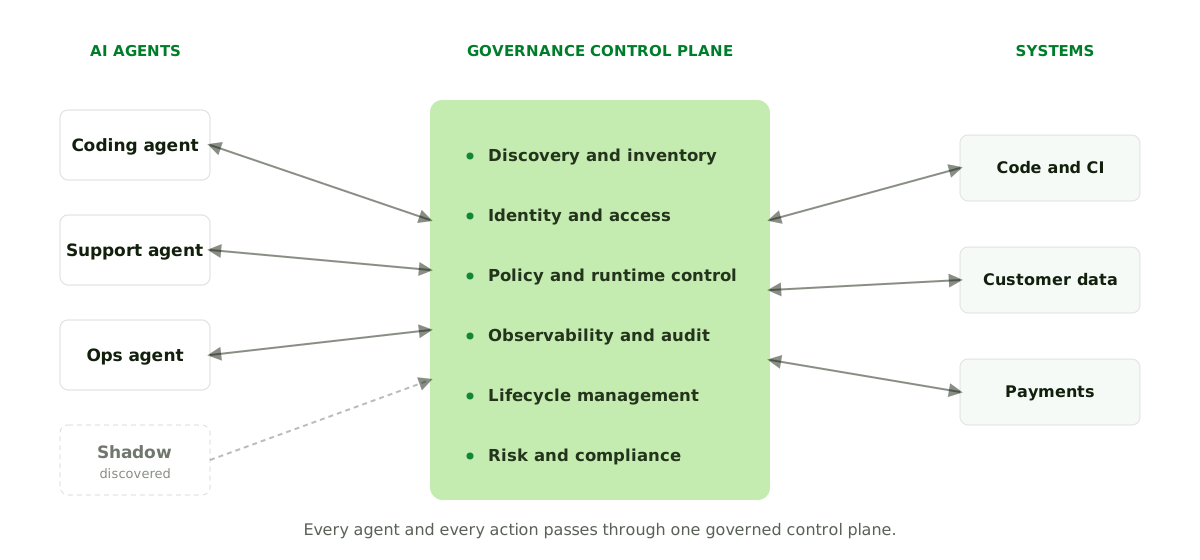
A workable framework rests on six pillars. Together they turn governance from a policy document into an operational control plane.
Discovery and inventory
You cannot govern an agent you do not know exists. The first pillar is a live inventory of every agent operating in the organization: built in-house, embedded in SaaS, or running on a developer's machine. This is what surfaces shadow agents and turns agent sprawl from an invisible risk into a managed list. Without it, every other pillar applies only to the agents you happened to remember.
Identity and access
Every agent should be a first-class identity with scoped, least-privilege permissions, not a shared service account borrowed from a human. Distinct agent identity is what makes the rest of governance possible: you cannot enforce least privilege, revoke a single agent, or attribute an action without it. This pillar, sometimes called agent identity governance, is the bridge between governance and day-to-day access control.
Policy and runtime control
Governance has to reach the moment an agent acts. Policy on every action decides what each tool call is allowed to do at runtime: a read runs automatically, a destructive operation is held for approval or blocked. This allow, escalate, or block model, enforced by a tool policies framework, is what separates governance that actually constrains agents from governance that only documents intentions.
Observability and audit
Every agent action should produce a record of what was requested, what policy decided, and what happened. Tamper-evident audit and observability is what closes the accountability gap: it lets you reconstruct an incident, prove least privilege, and hand a regulator evidence rather than assurances. Governance without an audit trail is a promise no one can verify.
Lifecycle management
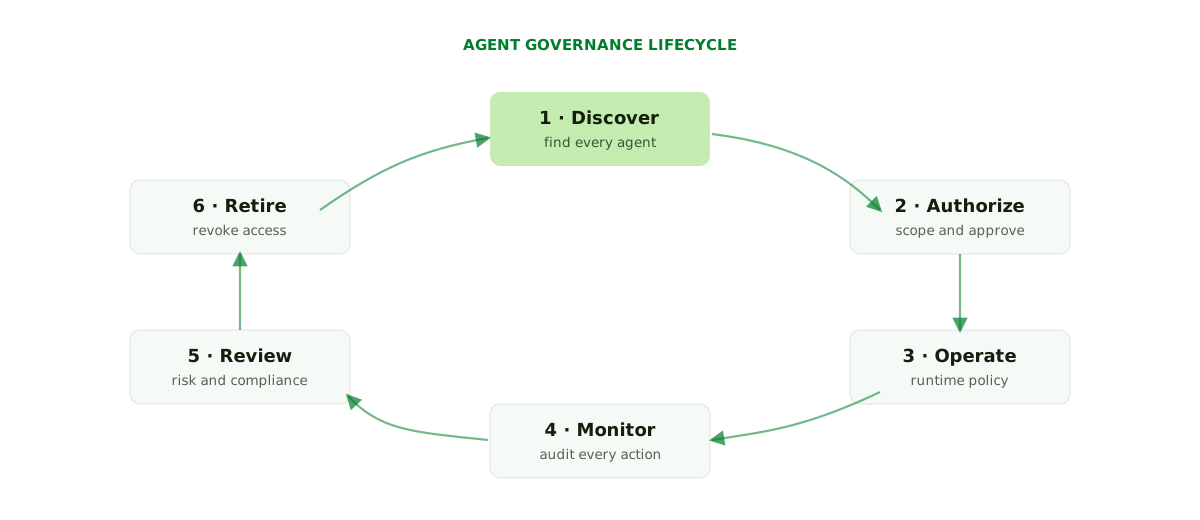
Agents are not deployed once and left alone. They are onboarded, changed, and eventually retired, and each transition is a governance event. New agents need approval and scoping before they touch production; changed agents need re-review; decommissioned agents need their credentials and access revoked so they do not become orphaned holes. Treating the agent lifecycle as a managed process is what keeps the inventory honest over time.
Risk and compliance
The final pillar maps everything above to the frameworks the organization answers to. Each agent should carry a risk classification proportional to what it can do, and the controls around it should map to the standards that apply, so governance produces compliance evidence as a byproduct rather than a separate scramble before an audit.
AI agent governance and compliance frameworks
Agent governance does not exist in a vacuum. It is increasingly the mechanism by which organizations satisfy AI-specific regulation and standards.
The NIST AI Risk Management Framework provides the govern, map, measure, and manage functions that agent governance operationalizes for autonomous systems. ISO/IEC 42001, the AI management system standard, expects documented controls and accountability that an agent inventory and audit trail directly support. The EU AI Act imposes obligations that scale with risk, which is exactly why per-agent risk classification matters. And in regulated sectors, agent actions fall under existing regimes: for financial entities, the controls overlap heavily with DORA compliance for AI. The OWASP Top 10 for LLM Applications and its agentic extensions give the threat vocabulary that risk classification draws on.
The practical point is that the same six pillars produce the evidence multiple frameworks ask for. Build governance once, map it to each standard, and the compliance work becomes reporting rather than reconstruction.
Best practices for AI agent governance
A few principles separate programs that hold up from programs that look good on a slide.
- Start with discovery. Inventory before policy. A governance program scoped to the agents you can name leaves the riskiest ones, the shadow agents, entirely ungoverned.
- Give every agent its own identity. Shared credentials destroy attribution and scoping before you begin.
- Govern actions, not just deployments. Design-time review is necessary but not sufficient; the controls that matter run at the moment the agent acts.
- Make high-risk actions pause. Define a class of operations that require human approval rather than executing on the agent's judgment alone.
- Test the controls, do not assume them. Continuous AI red teaming against your own agents turns governance from a paper policy into something you have actually verified holds.
- Treat governance as a lifecycle. Onboarding, change review, and decommissioning keep the inventory and the controls accurate as the fleet changes.
Common challenges
The same obstacles recur across organizations standing up agent governance.
Agent sprawl and shadow agents. The fleet grows faster than the inventory, and the agents created outside central IT are both the hardest to find and often the least governed.
The accountability gap. When agents act on delegated authority, tracing a harmful action back to an authorizing decision and a responsible owner is difficult unless identity and audit were designed in from the start.
Governance as an afterthought. Controls bolted on after agents are already in production are weaker and more disruptive than controls built into the deployment path. The cheapest time to govern an agent is before it ships.
Fragmented ownership. Agent governance spans security, platform, data, and compliance teams, and without a clear owner and a shared control plane, each team governs its corner and the gaps between them go unwatched. This is why agent governance and broader agentic AI security increasingly converge on a single enforcement point.
How Averta approaches AI agent governance
Averta turns the six pillars into one enforcement point rather than six disconnected tools. The Averta MCP Gateway acts as the control plane: every agent connects through it, which makes the inventory real, holds authentication centrally, and issues scoped, per-agent permissions instead of shared tokens. On top of that, a tool policies framework applies allow, escalate, or block decisions to every action at runtime, the classification engine inspects the inputs that drive agent behavior, and every decision lands in a tamper-evident audit trail. Continuous red teaming validates that the controls hold, and the audit evidence maps to the compliance frameworks the organization answers to. The result is governance you can see, enforce, and prove, on every agent and every action.
If you are scaling AI agents and need to govern them before the sprawl outpaces you, book a demo and we will show you how it works against your own fleet.
Frequently asked questions
What is the difference between AI governance and AI agent governance?
AI governance is the broad practice of managing AI responsibly, covering model risk, bias, data, and usage policy. AI agent governance is the subset focused on autonomous agents that take actions, adding the controls that only matter once software acts: per-agent identity, runtime policy on every action, and an audit trail of what each agent did.
What are the pillars of AI agent governance?
A practical framework rests on six: discovery and inventory, identity and access, policy and runtime control, observability and audit, lifecycle management, and risk and compliance. Together they turn governance from a policy document into an operational control plane.
Who owns AI agent governance in an enterprise?
It spans security, platform, data, and compliance teams, which is why fragmented ownership is a common failure mode. Mature programs name a clear owner and route agents through a shared control plane so the controls are enforced consistently rather than reimplemented per team.
How does AI agent governance map to compliance frameworks?
The same controls produce evidence for multiple standards. An agent inventory and audit trail support ISO/IEC 42001, per-agent risk classification supports the EU AI Act's risk-based obligations, and the NIST AI Risk Management Framework provides the govern, map, measure, and manage structure the program operationalizes.