June 22, 2026 ⋅ Averta Team ⋅ 14 minute read
What is AI Red Teaming? Methods, Tools & Process
AI red teaming stress-tests AI systems and agents for vulnerabilities before attackers do. The methods, attack categories, tools, frameworks, and how to defend.
A traditional penetration test asks whether an attacker can break into a system. AI red teaming asks a harder question: can the system be made to misbehave even when nobody breaks in? An AI model or agent can leak data, take an unauthorized action, or follow a hidden instruction while every server, network, and credential stays exactly as intended. Standard security testing was never built to find that.
That gap is why AI red teaming has moved from a research curiosity to a board-level expectation. Regulators now reference it, the major labs run it before every launch, and enterprises deploying AI agents are being asked to prove they have done it. This guide covers what AI red teaming is, how it works, the techniques and tools involved, how it applies to autonomous agents specifically, and why testing alone is only half the job.
What is AI red teaming?
AI red teaming is the structured, adversarial testing of an AI system to uncover ways it can be manipulated, misused, or made to cause harm, before real attackers or real users find them. Rather than probing infrastructure, it probes behavior: the model's responses, the agent's actions, and the boundaries that are supposed to hold under pressure.
The term borrows from military and cybersecurity practice, where a "red team" plays the adversary against the defending "blue team." Applied to AI, the red team's job is to think like an attacker or a misuse-minded user and find the inputs, contexts, and sequences that push an AI system past its intended limits. The output is a set of findings: concrete failure modes, ranked by severity, with reproductions where possible.
What makes it distinct is the target. The system under test does not behave deterministically. The same prompt can produce different outputs, a defense that holds nine times can fail on the tenth, and the attack surface is the model's reasoning itself, not just the code around it.
AI red teaming vs penetration testing and traditional red teaming
These terms are often used interchangeably, which causes confusion. They are related but distinct, and the difference matters when you scope work or buy services.
Penetration testing targets a defined system for known classes of technical vulnerability: misconfigurations, unpatched software, weak access controls, injection flaws in code. It is largely deterministic. A vulnerability either exists or it does not, and a fix closes it.
Traditional red teaming is broader: a goal-driven adversarial simulation across people, process, and technology to test whether an organization can detect and respond to a realistic attacker.
AI red teaming keeps the adversarial, goal-driven spirit of red teaming but points it at the AI layer. The "vulnerability" is often not a bug in the usual sense. It is a behavior: the model can be talked into ignoring its instructions, an agent can be steered into calling a tool it should not, or a poisoned document can redirect what the system does. Because behavior is probabilistic, findings are about likelihood and impact, not a simple present-or-absent state.
A useful way to hold the distinction: penetration testing asks "can this be broken into," AI red teaming asks "can this be made to do the wrong thing." Mature programs run both, and the term "AI penetration testing" is frequently used for the AI-focused subset that overlaps with red teaming. Whatever the label, the work that matters is adversarial testing of how the AI behaves under hostile input.
Why AI red teaming matters now
Three shifts moved AI red teaming from optional to expected.
AI now takes actions, not just answers. A chatbot that says something wrong is a content problem. An agent that reads a poisoned document and then deletes records, sends an email, or moves money is a security and operational incident. As agents gain tools and autonomy, the blast radius of a single manipulated decision grows, which is why red teaming has become central to agentic AI security.
The attack surface is public knowledge. Prompt injection, jailbreaking, and data extraction are well documented, with active research and open tooling. The techniques that red teamers use to find weaknesses are the same ones attackers and curious users already apply in the wild.
Regulators and frameworks now expect it. The NIST AI Risk Management Framework calls for adversarial testing, the EU AI Act requires robustness and risk testing for high-risk systems, and standards bodies increasingly treat red teaming as a baseline control rather than a nice-to-have. For regulated deployments, "we tested it adversarially" is becoming part of the evidence auditors expect.
How AI red teaming works: the methodology
Programs vary, but effective AI red teaming follows a repeatable loop rather than a one-time scan.
- Define objectives and scope. Decide what you are protecting against: data leakage, harmful output, unauthorized actions, policy violations. Pin down which systems, models, and tools are in scope, and what counts as a finding.
- Build the threat model. Map who would attack the system and how: external users, insiders, or poisoned content the system ingests. Identify the highest-impact failures worth hunting for first.
- Design and run attacks. Craft adversarial inputs and scenarios, both by hand and with automated tools, in an isolated environment. Probe the model and, critically, the actions an agent can take.
- Analyze and rank findings. For each success, record what was done, how reliably it reproduces, and what the real-world impact would be. Severity should reflect impact and likelihood, not novelty.
- Remediate and retest. Feed findings back into prompts, policies, guardrails, and runtime controls, then re-run to confirm the fix and check for regressions.
- Repeat continuously. Models change, prompts change, and new attack techniques appear weekly. A point-in-time test goes stale fast.
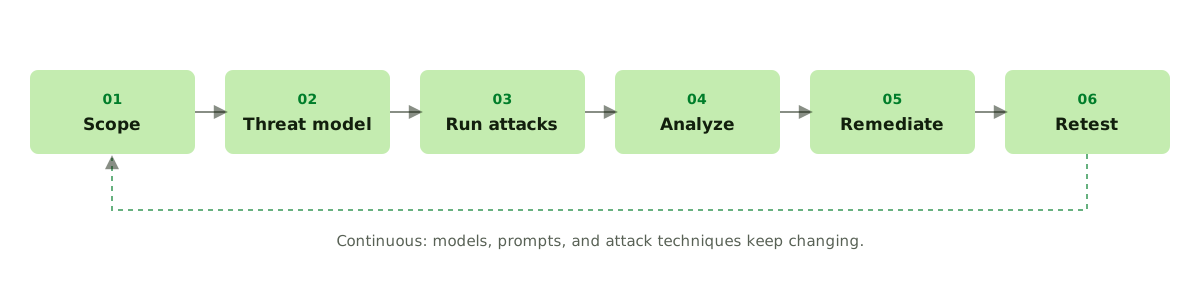
The loop matters more than any single exercise. AI systems are moving targets, so red teaming is a program, not an event.
AI red teaming techniques and attack categories
Red teamers work through a taxonomy of behaviors to elicit. The categories below describe what is being tested at the level of mechanism, not working payloads.
- Prompt injection. Getting the model to follow attacker-supplied instructions, either directly in the user input or indirectly through content the system reads, such as a web page, document, or tool result. See our guide to prompt injection.
- Jailbreaking. Bypassing the model's safety training to produce restricted output through role-play, obfuscation, or staged conversations. See AI jailbreaking.
- Sensitive data extraction. Coaxing the system into revealing training data, system prompts, secrets, or other users' information.
- Insecure output handling. Producing output that harms a downstream system, for example content that is rendered or executed without sanitization.
- Excessive agency and tool misuse. Driving an agent to call tools, access data, or take actions beyond what its task requires.
- Denial of service and denial of wallet. Forcing expensive or runaway behavior that exhausts budgets or availability.
- Harmful or biased generation. Eliciting unsafe, discriminatory, or non-compliant content the system is supposed to refuse.
A strong exercise does not stop at single prompts. It chains techniques, tests multi-turn conversations, and probes how defenses behave under sustained pressure rather than a single attempt.
Red teaming AI agents: a different attack surface
Most AI red teaming guidance focuses on the model. For autonomous agents, that is only the entry point. An agent reasons, plans, calls tools, reads results, and acts, and every step in that loop is something a red team must test. Because many of those tools are exposed through MCP servers, the test surface now includes MCP security and the integration layer, not just the prompt. This is where generic LLM testing falls short and where the real enterprise risk now lives.
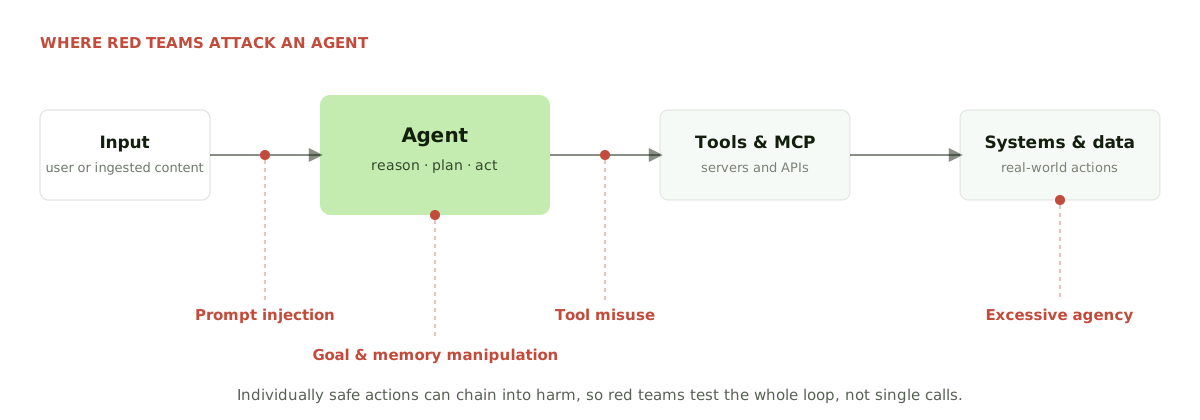
Agent red teaming adds attack categories that simply do not exist for a standalone model:
- Tool misuse. Can the agent be steered into invoking a tool it should not, or using a permitted tool in a harmful way? A poisoned input that turns "summarize this ticket" into "export the customer table" is an agent failure, not a content failure.
- Multi-step action chains. Individually safe actions can combine into harm. Red teaming has to follow the whole chain, not score each call in isolation.
- Goal and memory manipulation. Content the agent ingests can quietly rewrite its objective or poison its memory, so it pursues the attacker's goal while appearing to do its job.
- Excessive agency. If an agent holds broad credentials and tool access, a single successful manipulation reaches everything those credentials can touch. Scope is part of the test.
- Confused deputy. The agent is legitimate and trusted, so tricking it into acting is often easier and higher-impact than attacking the systems behind it.
Testing these requires red-teaming agents against their real tools in a controlled environment, watching not just what they say but what they try to do. The findings then point at controls that have to live at runtime, because an agent's behavior is decided in the moment, not at training time.
AI red teaming tools
The tooling landscape is maturing, with a mix of open-source frameworks and commercial platforms, which sit alongside the broader set of AI agent security tools. The most referenced open-source options include:
- Microsoft PyRIT, a Python framework for automating adversarial probing of generative AI systems.
- Garak, an open-source LLM vulnerability scanner that runs a library of known attack probes.
- Promptfoo, used for red-teaming and evaluation of LLM applications.
- Meta Purple Llama, a set of tools and benchmarks for AI safety and security testing.
These automate breadth: running many known attacks quickly and catching regressions. They do not replace skilled human red teamers, who find the novel, context-specific failures that scripted probes miss. In practice, strong programs combine automated coverage with manual creativity, and for agents they extend testing to the tools and actions the agent can reach, not just its text responses.
Frameworks and standards
Several frameworks give AI red teaming structure and map findings to recognized controls:
- OWASP Top 10 for LLM Applications, the standard vulnerability taxonomy for LLM and agent risks.
- MITRE ATLAS, an adversarial threat knowledge base for AI systems, modeled on ATT&CK, that catalogs real-world tactics and techniques.
- NIST AI Risk Management Framework, which positions adversarial testing within a broader risk program.
- EU AI Act, which requires robustness and risk testing for high-risk AI systems.
Mapping red team findings to these frameworks turns a list of failures into evidence an auditor or risk team can act on, and helps prioritize fixes against recognized categories rather than ad hoc severity.
Real-world AI red teaming in practice
The major AI labs treat red teaming as a launch gate, and their public practices are a useful model.
OpenAI runs an external red teaming network of domain experts alongside automated testing, and publishes the results in the system cards that accompany model releases. The mix of outside specialists and internal tooling is deliberate: experts find domain-specific harms that generic probes miss.
Microsoft operates a dedicated AI Red Team that has tested its production AI systems for years, and open-sourced the PyRIT framework so others can automate the same kind of probing. Its published lessons stress that AI red teaming is broader than security testing, covering safety and responsible-AI harms as well.
Google folds adversarial testing into its Secure AI Framework and combines red teaming with threat intelligence, so testing reflects how attackers are actually behaving rather than only theoretical risks.
Anthropic uses red teaming, including external and policy-focused testing, as part of how it evaluates models before release.
The common thread is that none of them treat red teaming as a one-time checkbox. It is continuous, blends human expertise with automation, and feeds directly into the controls that ship with the system. The same pattern applies to enterprises deploying agents: the value is not a single report, it is a standing program that keeps pace with how the system and its attackers change.
Why red teaming alone is not enough
Here is the uncomfortable truth about AI red teaming: it finds problems at a point in time, but AI systems fail in real time. A red team can prove that an agent can be manipulated into misusing a tool. It cannot stand between the agent and the tool on every future request. The model will be updated, new attack techniques will appear, and the same class of failure will resurface in a form the last test did not cover.
That is why red teaming and runtime defense are two halves of one program. Red teaming tells you where the boundaries are weak. Runtime controls enforce those boundaries continuously: classifying inputs before they reach the model, applying tool policies on every call, scoping what each agent can reach through an MCP gateway, and recording a tamper-evident audit of what actually happened. Findings from the red team become rules in the runtime, and the audit trail shows whether those rules held.
How Averta approaches AI red teaming
Averta Red Teaming tests AI agents the way they actually run: against their real tools and actions, not just their text output, surfacing the tool-misuse, action-chain, and excessive-agency failures that model-only testing misses. Those findings feed directly into the same platform that enforces them at runtime, so a weakness the red team discovers becomes a policy the gateway applies on every future call, with a tamper-evident record of every decision.
If you are deploying AI agents and need to both find and contain how they can be misused, book a demo and we will show you how red teaming and runtime governance work together against your own setup.
AI red teaming FAQ
What is red teaming in AI? It is adversarial testing of an AI system to find how it can be manipulated, misused, or made to cause harm before attackers or users do. It probes the model's behavior and an agent's actions, not just the surrounding infrastructure.
What is the difference between AI red teaming and penetration testing? Penetration testing looks for technical vulnerabilities in a defined system and asks whether it can be broken into. AI red teaming asks whether the AI can be made to do the wrong thing, testing probabilistic behavior rather than fixed flaws. Many teams run both.
Is AI red teaming a regulatory requirement? Increasingly, yes. The NIST AI RMF calls for adversarial testing, and the EU AI Act requires robustness and risk testing for high-risk systems, so for regulated deployments it is becoming part of expected evidence.
Can AI red teaming be automated? Partly. Tools like PyRIT, Garak, and Promptfoo automate breadth and regression testing, but skilled human red teamers are still needed to find novel, context-specific failures, especially for agents.
How often should you red team an AI system? Continuously, not once. Because models, prompts, and attack techniques change constantly, a point-in-time test goes stale, and red teaming works best as an ongoing program paired with runtime controls.