June 9, 2026 ⋅ Averta Team ⋅ 18 minute read
Top 10 AI Agent Security Tools & Platforms (2026)
The top 10 AI agent security tools and agentic AI security solutions in 2026. Ranked by runtime depth, MCP support, and ecosystem fit. Side-by-side comparison.
AI agents have moved out of the lab. They are reading email, writing code, calling APIs, paying invoices, reading customer data, and connecting to MCP servers in production at companies that, two years ago, were still arguing about whether a chatbot needed a privacy review.
That shift has created a new buyer's problem. The "AI security" category most CISOs evaluated in 2024 was really LLM input/output filtering for chatbots. AI agents are different. They have tools, identity, persistence, and the ability to chain actions across systems they were never previously authorized to touch.
This is the 2026 guide to the top 10 AI agent security tools and agentic AI security solutions that do the most across the runtime decision points that matter for agentic systems: input, plan, tool call, data, output, identity, and audit. Each entry covers what the product does, pros, cons, and the buyer profile it fits.
Jump to the side-by-side comparison or the how to choose section if you already know your stack.
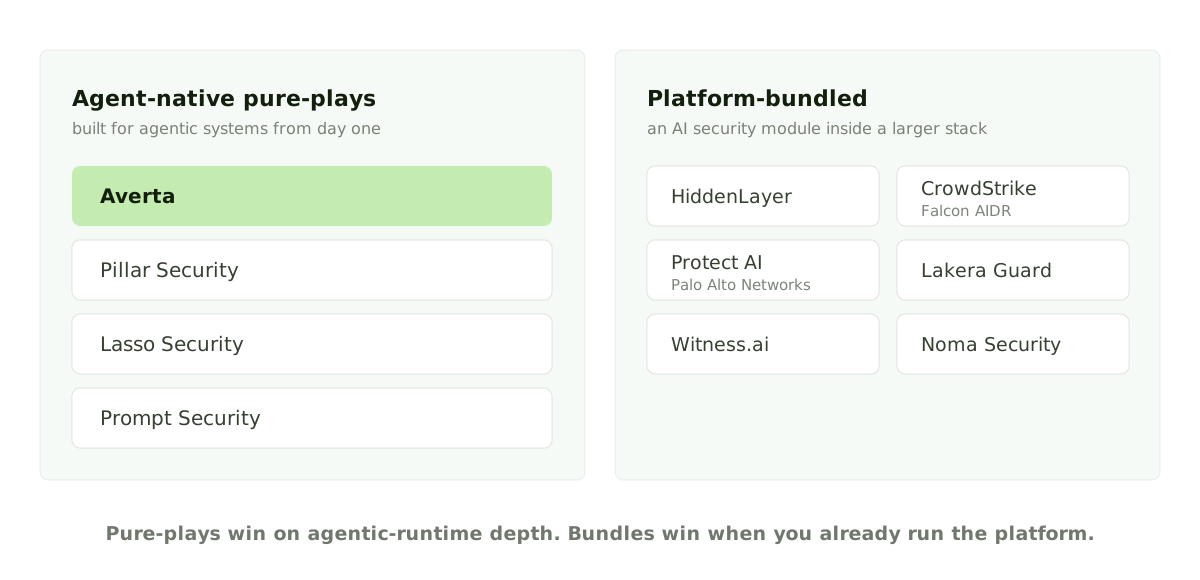
TL;DR. AI agent security tools are runtime systems that govern what autonomous AI agents are allowed to read, reach, and do, on every prompt and every tool call. The 2026 leaders split into agent-native pure-plays (Averta, Pillar, Lasso, Prompt Security) and platform-bundled options (HiddenLayer, CrowdStrike Falcon AIDR, Protect AI / Palo Alto, Lakera, Witness.ai, Noma). Pure-plays win on agentic-runtime depth; bundles win when the buyer is already standardized on the platform vendor.
How we ranked the top 10 AI agent security tools
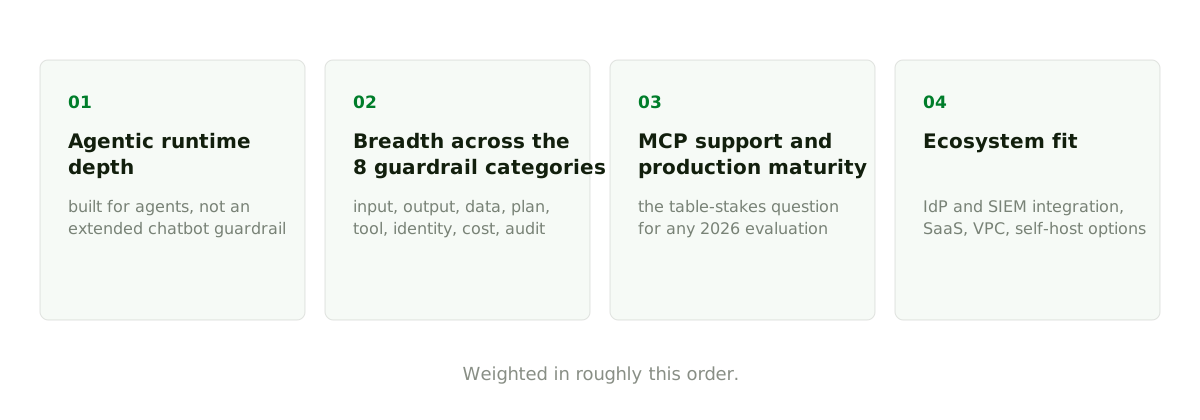
The ranking weighs four things in roughly this order:
- Depth on agentic-specific runtime. Vendors built for agentic systems rank above vendors that extended a chatbot guardrail to handle agents.
- Breadth across the eight guardrail categories. Input, output, data, plan, tool-call, identity, cost and rate, and audit. The more of those a vendor covers natively, the higher.
- MCP support and production maturity. A clean answer to "how do you handle MCP?" is now the table-stakes question for any serious agentic AI security platform.
- Ecosystem fit. Identity-provider integration, SIEM and observability hooks, and deployment optionality (SaaS, VPC, self-host, airgapped) decide which buyers can adopt the vendor without a six-month integration project.
1. Averta
The pick for teams that want an agent-native runtime layer, MCP control, and audit-grade evidence in one platform.
Averta is the AI agent operating system for safe, governed autonomous execution. Rather than a single firewall or filter, Averta provides CISOs and developers with a multi-layered agentic AI security platform that applies classification, policy, and runtime enforcement to every agent action and every MCP tool call. Think of it as an immune system for AI agents: distinct layers that complement each other instead of one rule engine that has to do everything.
Architecturally, Averta is made up of six products plus a developer surface:
- Classification Engine. AI guardrails that classify every prompt, tool call, and output for intent and risk. Catches prompt injection, jailbreaks, and unsafe outputs at the execution boundary, before the model acts.
- Tool Policies Framework. AI agent governance for every tool call. Allow, escalate, or block, with full attribution. Policy lives in one place that security owns, not scattered across system prompts.
- MCP Gateway. Per-agent MCP permissions, MCP authentication held at the gateway, and a registry that consolidates remote, self-hosted, and custom MCP servers behind one governed proxy. Stops token sprawl and shadow MCP connections.
- PII Redaction & AI DLP (Output Classifier). PII, secrets, system-prompt leakage, and harmful content detection on every response.
- Audit & Observability. Tamper-evident AI audit trail of every prompt, decision, and action. Conduct-ready replay, mapped to SOC 2, ISO 27001, ISO 42001, EU AI Act, and DORA.
- Averta Red Teaming (RED). Adversarial campaigns and continuous AI red teaming against your production agents. Findings become regression tests so old failures stay closed.
- SDK + Dashboard. Drop in at the SDK, proxy, or gateway, across every model and framework, without rewriting agents. Model-agnostic: works with OpenAI, Anthropic, Google, Mistral, and open-source models.
The product targets dual buyers from day one: a CISO who needs auditable controls and policy attribution, and a platform engineering team who needs an SDK they can deploy without operational pain. Solution pages exist for CISOs, developers, financial services, healthcare, technology, public sector, and inference providers.
Pros
- Purpose-built for agentic systems, not extended from a chatbot guardrail
- Coverage across all eight guardrail categories (input, output, data, plan, tool-call, identity, cost, audit) inside one platform
- First-class controls for tool calling, MCP server interactions, and agent-to-agent workflows
- Sub-40ms p99 classification latency, 98.8% precision, sub-2% false positive rates
- SDK and Dashboard ship together so the security and engineering buyer get the same product
- VPC-friendly deployment for sovereignty-sensitive customers
- Audit-grade records mapped to SOC 2, ISO 27001, ISO 42001, EU AI Act, and DORA
Cons
- Newer vendor, generally available since 2026
- Sales-led and demo-driven; no self-serve trial today
2. Pillar Security
The pick for teams that want discovery, runtime guardrails, and red teaming in one platform, with VPC deployment.
Pillar Security markets a single platform to discover, govern, and secure every AI agent across the organization. The capability set spans AI discovery (agents, models, prompts, tools, MCP servers, coding agents), red teaming, runtime guardrails, data privacy controls, and compliance automation. Deployment options include self-hosted on the customer's VPC and SaaS, with SOC 2 Type II certification.
Pros
- Genuinely broad: discovery + runtime + red teaming + governance under one roof
- VPC self-hosted deployment for sovereignty
- Strong on agentic interaction patterns, tool orchestration, and permission escalation
- Named customer references (Eleos, Tavily, SimilarWeb)
Cons
- Broader product means a longer learning curve and a more involved POC
- Self-hosted deployments add operational overhead
- Less brand visibility than Lakera or HiddenLayer in the educational-content space
3. HiddenLayer
The pick for regulated and government environments and for teams that want runtime plus red teaming plus model scanning.
HiddenLayer markets one of the most comprehensive AI security platforms, with modules across discovery, supply-chain security, attack simulation (red teaming), and runtime protection. It generates an AI Bill of Materials before deployment, supports CI/CD and MLOps integrations, and runs in airgapped environments. A dedicated agentic and MCP protection module covers session-level visibility, tool-call inspection, and runtime enforcement for chained models.
Pros
- Broadest platform on the list (discovery + scanning + red team + runtime + AI BOM)
- Airgapped and sensitive-environment deployments supported
- Federal-government and regulated-industry customer references
- Strong research credibility
Cons
- Enterprise-priced; harder fit for mid-market
- The platform is centered on model lifecycle; agentic-runtime is a newer addition
- Less specialized on MCP and pure agent runtime than agent-native vendors
4. CrowdStrike Falcon AIDR (formerly Pangea AI Guard)
The pick for teams already standardized on CrowdStrike Falcon for endpoint and identity.
Pangea's AI Guard is now CrowdStrike Falcon AIDR. The acquisition gave CrowdStrike a runtime AI defense module that ships inside the broader Falcon platform and reuses CrowdStrike's existing endpoint footprint as a control point. Marketed claims include 99 percent prompt-attack detection efficacy, sub-30-millisecond decision latency, and coverage of 180-plus prompt injection techniques.
Pros
- Native integration with the rest of Falcon (EDR, identity, response automation)
- Endpoint-based control point catches AI traffic that bypasses the network
- Strong vendor backing and incident-response integration
- Sub-30ms decision latency claim
- Maps relationships across users, prompts, models, agents, and MCP servers
Cons
- Best fit only if you already run CrowdStrike Falcon
- Acquired product still being integrated into the broader Falcon stack
- Endpoint-as-control-point is not the right shape for every agentic deployment
5. Lakera Guard
The pick for teams that want a fast, SaaS-delivered runtime filter for chatbots and LLM apps.
Lakera markets Lakera Guard as runtime security for GenAI. The product is a SaaS-delivered AI application firewall with real-time threat detection, content guardrails, a security center dashboard, and SIEM and threat-intel integrations. It is SOC 2, GDPR, and NIST AI RMF aligned. Lakera is also notable for the volume of free educational content it produces, including the Gandalf prompt-injection game.
Pros
- Established runtime brand with strong customer references (Dropbox, Cohere)
- Fast to deploy; SaaS API
- Compliance alignment is mature (SOC 2, GDPR, NIST)
- Best-in-class educational content
Cons
- Leans toward chatbot and conversational use cases more than full agentic systems
- MCP and multi-tool agent coverage is less central than for agent-native vendors
- SaaS-only; no VPC or self-host option
6. Protect AI (Palo Alto Networks)
The pick for teams already in the Palo Alto Prisma AIRS / Cortex ecosystem.
Protect AI was acquired by Palo Alto Networks in 2025. The product line includes Guardian (model security), Recon (automated red teaming), and Layer (runtime), plus widely-used open-source tools (ModelScan, LLM Guard) and a community of 17,000-plus security researchers via the huntr partnership.
Pros
- Comprehensive platform: model + red team + runtime
- Strong open-source presence (ModelScan, LLM Guard) gives developer credibility
- Palo Alto distribution post-acquisition
- huntr researcher community is a real differentiator
Cons
- Acquired in 2025; integration with Prisma AIRS still in flight
- Standalone purchase increasingly bundled into AIRS deals
- Lighter on MCP-specific runtime coverage than pure-plays
- No customer case studies on the homepage
7. Prompt Security
The pick for teams that need employee shadow-AI, coding-agent, and runtime coverage from one vendor.
Prompt Security takes a three-front approach: Employee-AI for shadow AI on the workforce side, Developer-AI for IDE-level guardrails on AI coding assistants, and Runtime for inline protection in homegrown applications. The company recently launched an MCP Gateway it describes as a comprehensive solution for MCP security. Deployment is available as SaaS or self-hosted.
Pros
- Three-front coverage (employee, developer, runtime) under one vendor
- MCP Gateway is one of the most explicit MCP-specific products on the market
- SaaS or self-hosted
- Strong customer logo book (HiBob, Cymulate, Zeta Global, NYT, 10x Banking)
Cons
- Broad scope means paying for capabilities you may not use
- Not the deepest single-product in any one of the three fronts
- More involved deployment than a single-purpose tool
8. Lasso Security
The pick for teams that want intent-based detection plus discovery, posture, red team, and runtime under one roof.
Lasso Security markets an "Intent Security Framework" that analyzes the intent behind agent behavior rather than relying purely on signature-style rules. The product spans CI/CD discovery, posture management, automated red teaming with a 3,000-plus attack library, and runtime enforcement, with claims of 98.6 percent threat detection accuracy and sub-50-millisecond latency.
Pros
- Intent-based framing is durable as new attack variants emerge
- Multi-layer (CI/CD + posture + red team + runtime) from one vendor
- Strong customer roster including the US Department of Homeland Security
- Sub-50ms latency claim, 3,000-plus attack library
Cons
- Newer to the runtime category than Lakera or HiddenLayer
- "Intent" framework is still proving in production at scale
- Less brand visibility in the educational-content space
9. Witness.ai
The pick for regulated buyers who want observe / protect / control as a unified single-tenant platform.
Witness.ai markets a unified AI security and governance platform built around three pillars: Observe (inventory, real-time monitoring, agent tracking), Protect (runtime defense, jailbreak and prompt injection blocking, output filtering, red teaming), and Control (policy-based governance, model routing, audit trails, sensitive data redaction). Deployment is single-tenant with data sovereignty options for regulated industries.
Pros
- Genuine unification across observe, protect, and control
- Single-tenant deployment for regulated industries
- Discovers MCP servers and tools as part of inventory
- Customer references include a top-10 airline and InComm Payments
Cons
- Posture-led rather than runtime-led; runtime-first buyers will need to evaluate the protect layer carefully
- Smaller deployment footprint than category leaders
- Recent entrant to the runtime conversation
10. Noma Security
The pick for SecOps teams that want AISPM framing (CSPM-shaped workflows) plus runtime in one product.
Noma Security markets an AI security platform for LLMs, RAG, and AI agents, built on three layers: discovery and visibility (models, agents, MCP servers, data sources), AI Security Posture Management (AISPM), and runtime protection. The product also includes red teaming and compliance modules.
Pros
- AISPM framing fits naturally into existing CSPM-shaped SecOps workflows
- Real-time threat detection across all agents and MCP servers
- Strong customer references (UiPath, Endor Labs, Best Buy, Nielsen)
- Discovery + posture + runtime + red team in one product
Cons
- Posture-first rather than runtime-first
- Newer than the established category leaders
- Less specialized on agentic-runtime depth than pure-plays
Side-by-side comparison of the top 10
| Rank | Vendor | Core fit | Deployment | MCP support | Public customers |
|---|---|---|---|---|---|
| 1 | Averta | Agent-native runtime, breadth across all 8 guardrail categories | SDK + control plane (SaaS or VPC) | Native MCP Gateway | Sales-led, references on demo |
| 2 | Pillar Security | Runtime + discovery + red teaming with VPC option | SaaS or VPC self-host | Built-in | Eleos, Tavily, SimilarWeb |
| 3 | HiddenLayer | Broadest platform, regulated and government | SaaS, on-prem, airgapped | Built-in | NFL, GitLab, federal |
| 4 | CrowdStrike Falcon AIDR | Runtime AI inside Falcon | Falcon platform | Built-in | Grand Canyon Education, Deskpro |
| 5 | Lakera Guard | Fast runtime filter for chatbots and LLM apps | SaaS API | Roadmap | Dropbox, Cohere |
| 6 | Protect AI (Palo Alto) | Model + red team + runtime + open source | SaaS, modular | Lighter | Partnerships heavy, fewer logos |
| 7 | Prompt Security | Employee + developer + runtime + MCP Gateway | SaaS or self-host | MCP Gateway | HiBob, NYT, 10x Banking |
| 8 | Lasso Security | Intent-based, multi-layer | SaaS, multi-layer | Tool-call coverage | US DHS, eToro, Optibus |
| 9 | Witness.ai | Posture + protect + control, single-tenant | SaaS single-tenant | Built-in | Top-10 airline, InComm |
| 10 | Noma Security | AISPM-shaped runtime + posture | SaaS | Built-in | UiPath, Best Buy, Nielsen |
How to choose the right AI agent security tool
Whether you are evaluating AI agent security software, a standalone platform, or an enterprise-wide solution, the questions a buyer should ask are the same, in order.
1. Do you know what AI agents and AI usage are running in your environment? If not, the first investment is discovery. Pillar, Witness, Noma, Reco, and Harmonic all do this; the first three combine it with runtime so you do not need a separate purchase.
2. What is the largest concentration of risk? Built applications and homegrown agents calling tools and APIs in production point to a runtime-first vendor: Averta, Lasso, Prompt Security, HiddenLayer, Lakera. Employees pasting data into chatbots and using personal Copilot accounts point to Harmonic or Reco as a complement.
3. What platform are you standardized on? Already on Falcon? Evaluate CrowdStrike Falcon AIDR before standalone runtime tools. Already on the Palo Alto network and endpoint stack? Evaluate Prisma AIRS plus the integrated Protect AI components. Multi-cloud or no strong platform alignment? An agent-native pure-play (Averta, Pillar) usually fits better than a cloud-native guardrail.
4. Do you also need pre-launch and ongoing adversarial testing? From the same vendor as runtime: Averta, Pillar, Lasso, HiddenLayer. Best-of-breed: add Mindgard or Troj.ai alongside your runtime choice.
5. What is your deployment requirement? SaaS-only is fine for most. Customer VPC or self-hosted: Averta, Pillar Security, Prompt Security.
AI agent security outlook for 2026 and 2027
Three things to watch.
Bundling pressure from the platform vendors will keep increasing. Palo Alto Networks (Prisma AIRS + Protect AI + CyberArk) and CrowdStrike (Falcon AIDR) will push hard on "consolidate to one stack." That is a real value proposition for buyers already standardized on one of them, and it raises the bar on best-of-breed pure-plays to demonstrate why the integration tax is worth paying.
MCP security will continue to fragment. Some vendors are betting on MCP gateways as a chokepoint. Others are betting on inline runtime enforcement that handles MCP as one of several agent integration patterns. The right answer probably depends on how your agents are deployed: a small number of well-known MCP servers favors a governed MCP gateway, a heterogeneous estate favors inline runtime.
The boundary between AI agent security and identity will keep blurring. Okta and CyberArk are claiming the identity layer aggressively, but runtime vendors increasingly need to make policy decisions based on identity context, and several already integrate with Okta, Auth0, and CyberArk. Expect tighter partnerships in 2026 and possibly more acquisitions.
Frequently asked questions
What are AI agent security tools?
AI agent security tools are runtime systems that enforce AI agent access control over what autonomous AI agents are allowed to read, reach, and do at runtime, on every prompt and every tool call. Unlike LLM input/output filters built for generative AI security, agentic AI security solutions cover the full execution path: input classification, tool-call governance, MCP gateways, identity-aware policy, output redaction, and audit-grade evidence for every action.
How is AI agent security different from LLM security?
LLM security stops at the model's text output, focusing on prompt injection in chat-style interactions. AI agent security extends through the agent's actions, the tools it calls, the systems it touches, and the chains it forms with other agents and MCP servers. Where LLM guardrails ask "is this output safe?", AI agent security tools ask "is this action sanctioned by policy, attributable to a user, and recorded for audit?".
What is an agentic AI security platform?
An agentic AI security platform is a runtime control layer built specifically for autonomous AI systems that hold tools, persist state, and take actions on behalf of users. The core components are typically: a classification engine for prompts and outputs, a policy framework for tool-call governance, an MCP gateway for credential containment and per-agent permissions, and an audit layer that produces tamper-evident records of every decision.
What is an MCP gateway and why does it matter for AI agent security?
An MCP gateway is a security and governance layer that sits between AI agents and the MCP servers they use. Instead of each agent connecting directly to each MCP server with its own credentials, the gateway exposes a single governed endpoint, enforces per-agent tool permissions, holds the downstream credentials, and produces an audit trail for every tool call. It is the difference between every agent holding the keys to every system and one place where access is granted and revoked.
How do AI agent security solutions help with SOC 2, ISO 27001, and the EU AI Act?
Audit-grade AI agent security solutions produce structured, tamper-evident records of every agent prompt, decision, tool call, and output, mapped to the controls these frameworks expect. The record shows which agent acted, under whose identity, against which policy, with what result, and at what time. That is the evidence layer SOC 2, ISO 27001, ISO 42001, the EU AI Act, and DORA all require, regardless of the underlying model or framework.
How should I evaluate AI agent security companies in a POC?
Run the POC against your own production traffic in shadow mode. Measure precision, recall, false-positive rate, and p99 latency on real workloads, not the vendor's demo dataset. Check coverage on the eight guardrail categories (input, output, data, plan, tool-call, identity, cost, audit), then test the MCP integration explicitly: per-agent permissions, credential containment, and audit trail completeness on every tool call. The best AI agent security tools should hold up against your own traffic before they hold up against any benchmark.
Have we missed a vendor that belongs in this list? Email research@averta.io.