June 9, 2026 ⋅ Averta Team ⋅ 19 minute read
Agentic AI Security: A 2026 Defender's Guide
Agentic AI security defends AI systems that act autonomously. The 2026 threat model, the 8-layer defense, a compliance crosswalk, and a 90-day plan.
By mid-2026, agentic AI is in production at every kind of enterprise. Coding agents have shell access to repositories. Customer-service agents read CRMs and post to Slack. Finance agents query ledgers and trigger payments. Multi-agent workflows pass tasks across systems with no human in the loop between any two steps. Every one of these deployments is an authorization surface, an exfiltration channel, and a regulatory obligation.
Agentic AI security is the discipline of defending those systems. It is not a rebrand of LLM security. It is not a feature of AI governance. It is the operational layer that decides, in real time, what an autonomous AI system is allowed to read, plan, do, and say, with audit trails strong enough to prove what happened. Securing agentic AI is a different job from securing a chatbot, and treating it as the same job is how most production incidents start.
The sections below cover what agentic AI security is, why it is different from chatbot-era AI security, the working threat model, the eight-layer defense architecture that defends against it, the compliance crosswalk to OWASP, NIST AI RMF, ISO 42001, and the EU AI Act, a 90-day implementation plan, a public incident roundup, and a maturity self-assessment for security and platform leaders.
What is agentic AI security?
Agentic AI security is the defender's discipline for AI systems that hold tools, persist state, and take autonomous actions. It governs every input the agent ingests, every plan it forms, every tool it calls, every identity it acts under, every output it produces, and every action it commits, with audit strong enough to support incident response and regulatory reporting.
The shorthand: agentic AI security is what makes the difference between an AI agent doing the job it was deployed for and an AI agent becoming a privilege-escalation event. Where LLM security stops at the model's text output, agentic AI security extends through the agent's actions, the systems it touches, and the chains it forms with other agents.
Why agentic AI cybersecurity is different from AI security
The "AI security" label most CISOs evaluated through 2024 was, in practice, LLM input-output filtering for chatbots. Agentic systems break the assumptions that approach was built on, which is why agentic AI cybersecurity has emerged as its own discipline rather than a feature of the old one.
Agents act, not just answer. A jailbroken chatbot says something offensive. A jailbroken agent transfers money, drops a database, or compromises a downstream agent. The harm crosses from content into action.
Agents have identity. Every agent that talks to a system needs an identity to talk under. Identity sprawl, credential reuse, and unscoped permissions are first-order risks for agents in a way they were not for chatbots. Okta's AI Agents at Work 2026 survey found that only 22 percent of organizations treat agents as independent identities; the rest mostly run agents on shared API keys.
Agents persist. Memory, vector stores, session logs, and environment state mean that compromise from one session can survive into future ones. A successful prompt injection can be a permanent backdoor.
Agents chain. Multi-agent workflows pass outputs from one agent to another. A poisoned upstream agent compromises every downstream agent that trusts it.
The data path is bigger. RAG, tool results, MCP servers, agent-to-agent messages, persistent memory, and screen-watching desktop agents all bring untrusted text into the model's context. LLM-era input filtering was designed for one input field; agentic systems have ten.
For each of these properties, the right control is not a chatbot guardrail extended one feature at a time, and it is not the model's own safety training, which stops at the model layer. It is a runtime layer designed for autonomous systems from the start.
The agentic AI threat model
The working threat model for agentic AI in 2026 is the OWASP Top 10 for Agentic Applications 2026 (ASI01:2026 through ASI10:2026, released in December 2025 and peer-reviewed by more than 100 security researchers), supplemented by the relevant entries from the OWASP Top 10 for LLM Applications (LLM01:2025 through LLM10:2025) and the broader 15-threat taxonomy in the OWASP Agentic AI Threats and Mitigations document.
The categories below are the practitioner's view of how those frameworks land in production.
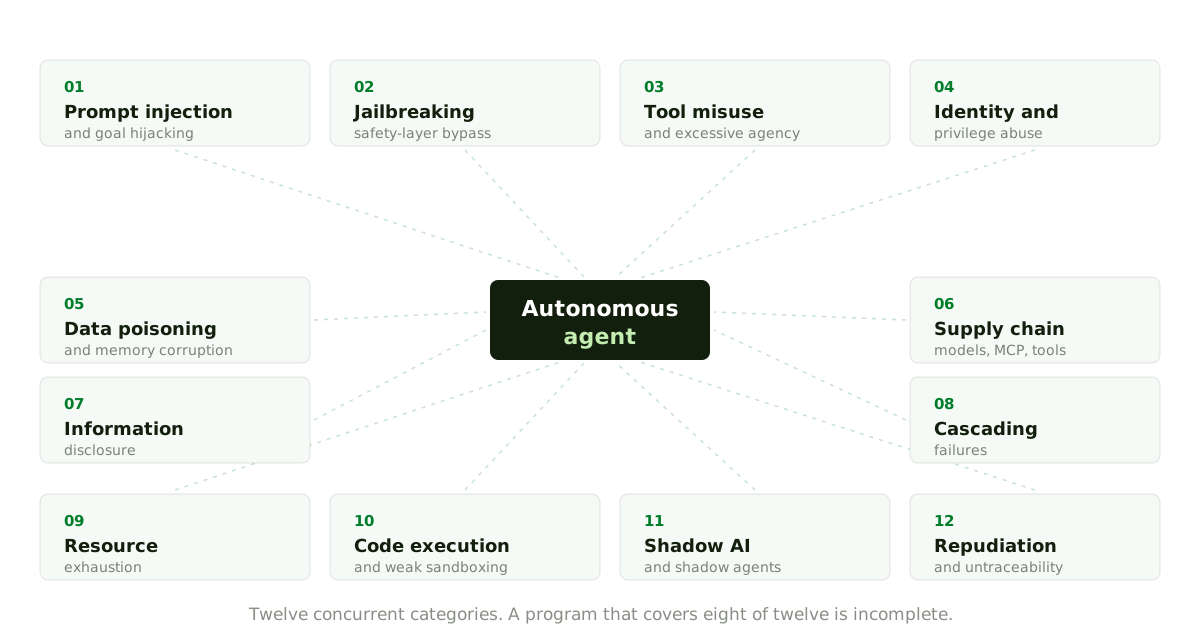
1. Prompt injection and goal hijacking. The most-cited threat. The agent ingests text (from user input, retrieved documents, tool results, MCP resources, or upstream agents) and the text contains instructions that override the developer's intent. ASI01:2026 Agent Goal Hijack is the agentic framing; LLM01:2025 Prompt Injection is the model-level one. For the deeper walkthrough see our What is Prompt Injection guide.
2. Jailbreaking. Crafted inputs bypass the model's safety layer. On a chatbot the worst case is content-policy violation. On an agent it is privilege escalation.
3. Tool misuse and excessive agency. The agent calls a tool in a way the developer did not intend, often because the agent has more capability than the use case requires, or chains tools through unsafe recursion. ASI02:2026 Tool Misuse & Exploitation and LLM06:2025 Excessive Agency are the canonical references.
4. Identity and privilege abuse. Agents that hold long-lived credentials, agents that act under privileged identities for entire sessions, and agents whose delegated authority or ambiguous identity leads to unauthorized actions. ASI03:2026 Agent Identity & Privilege Abuse covers the category.
5. Data poisoning and memory corruption. Hostile content placed in training data, retrieval indexes, or agent memory persists across sessions and influences future reasoning. RAG poisoning is the operationally most common form. ASI06:2026 Memory & Context Poisoning plus LLM04:2025 Data and Model Poisoning.
6. Supply chain risks. Compromised models, MCP servers, tool descriptions, schemas, and prompts that agentic systems dynamically integrate. ASI04:2026 Agentic Supply Chain Compromise plus LLM03:2025 Supply Chain. For the MCP-specific threat model and hardening checklist, see our MCP security guide.
7. Sensitive information disclosure. The agent leaks confidential data through outputs, tool-call parameters, or system-prompt exposure. LLM02:2025 is the canonical reference; on agents the leak paths multiply because every tool call is an output channel.
8. Cascading failures and hallucination propagation. A hallucinated or corrupted output from one agent becomes the input of another, compounding error rates non-linearly across connected systems. ASI08:2026 Cascading Agent Failures, with insecure inter-agent communication (ASI07:2026) as a common amplifier.
9. Resource exhaustion and runaway loops. Cost spikes, recursive tool-call chains, denial of service against downstream systems. LLM10:2025 Unbounded Consumption, and a frequent trigger for ASI08-style cascades.
10. Unexpected code execution and inadequate sandboxing. Agent-generated or agent-triggered code executes without sufficient validation or isolation. ASI05:2026 explicitly captures this category, and it is the highest-stakes risk for coding agents with shell access.
11. Shadow AI and shadow agents. AI usage and agent deployments the security team did not authorize. Discovery is the precondition for every other control.
12. Repudiation and untraceability. When something goes wrong, audit trails are insufficient to reconstruct what happened. T8 in the broader OWASP taxonomy. The compliance and incident-response consequence of insufficient audit.
The official Agentic Top 10 also names two categories this practitioner model folds into program design rather than runtime controls: ASI09:2026 Human-Agent Trust Exploitation (agents misleading the humans who oversee them through false explanations or authority claims) and ASI10:2026 Rogue Agents (goal drift, collusion, and emergent behavior beyond intended objectives). Both are strong arguments for the audit and plan-review layers below.
The pattern across the list: agentic AI security is not one threat. It is twelve concurrent threat categories that each need their own coverage. A program that covers eight of twelve is incomplete, and the gaps tend to be where attackers concentrate.
The 8-layer agentic AI security framework
The defender's response to a multi-category threat model is a multi-category control surface. The eight-layer framework below is the working architecture for a runtime program.
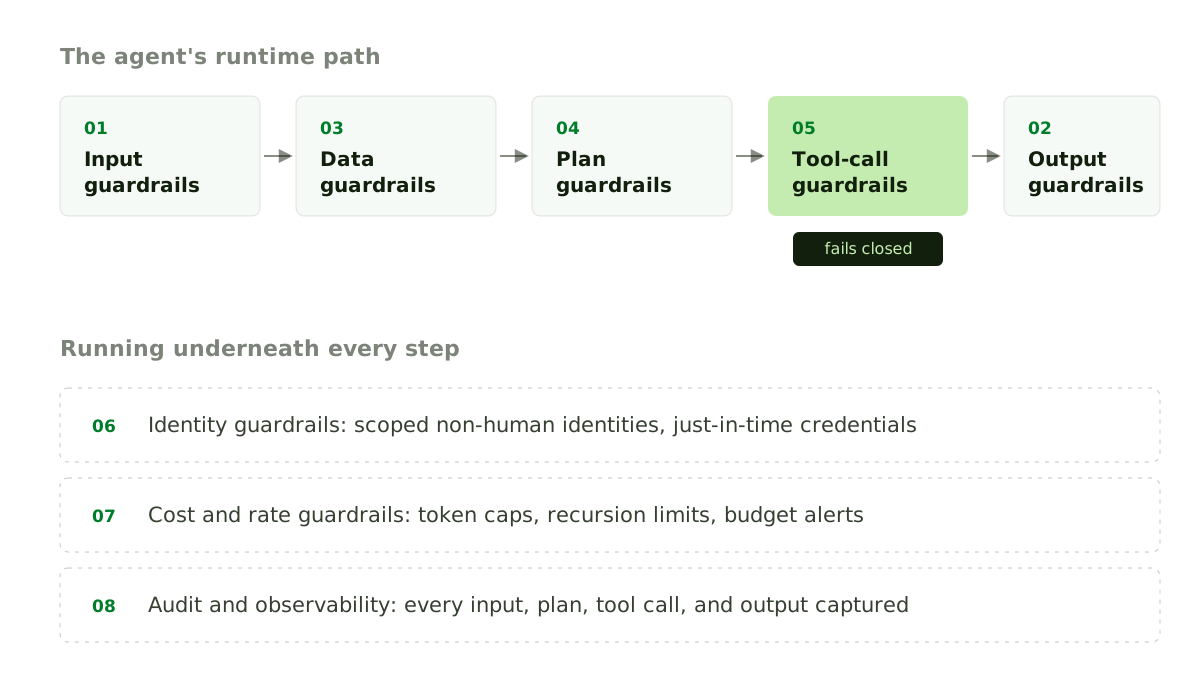
Layer 1: Input guardrails. Classify every text the agent ingests, regardless of source: user prompts, retrieved documents, tool results, MCP resources, agent-to-agent messages. Catches the bulk of prompt injection, jailbreak, and content-policy violations.
Layer 2: Output guardrails. Inspect what the agent says or writes before it reaches the user, the next agent, or the next tool. Catches sensitive data exfiltration, leaked system prompts, off-policy responses, hallucinated outputs that propagate downstream.
Layer 3: Data guardrails. Govern data flowing into and out of the agent's context. PII detection and redaction, retrieval scoping, ACL alignment between source documents and the calling user, classification of vector store entries, controls on memory writes.
Layer 4: Plan guardrails. Inspect the agent's plan before tool calls execute. Block plans that exceed the agent's chartered scope, plans that involve sequences a human should approve, plans whose intent does not match the request. The single highest-leverage agentic-specific control.
Layer 5: Tool-call guardrails. Govern every tool invocation. Tool allowlisting, parameter validation, scope alignment with the calling user's permissions, identity-bound enforcement, rate limits per tool, audit. For MCP-mediated tools, a governed MCP gateway is the cleanest place to enforce per-agent permissions. The boundary that fails closed when other layers are bypassed.
Layer 6: Identity guardrails. Scoped non-human identities, just-in-time credentials, identity-aware policy decisions, mutual authentication for agent-to-agent communication, the building blocks of AI agent access control. Inputs to runtime decisions made elsewhere; foundational rather than stand-alone.
Layer 7: Cost and rate guardrails. Hard token caps, recursion-depth limits, per-tool rate limits, total-run cost ceilings, real-time budget alerting. Stops runaway loops, recursive chains, and resource-exhaustion attacks.
Layer 8: Audit and observability. Every input, plan, tool call, tool result, and output captured and retained. Tamper-evident logs. Integration with the SIEM and the incident response process. Required for almost every regulatory framework that touches AI.
A working production deployment runs all eight. Programs that cover four or five typically miss the agentic-specific layers (plan, tool, identity) where the privilege-escalation risk concentrates.
Where agentic AI security fits in OWASP, NIST AI RMF, ISO 42001, and the EU AI Act
The defender's program crosswalks cleanly to the major regulatory and standards frameworks. The mapping below is at the level of category, not exact clause.
| Framework | What it covers | How agentic AI security maps |
|---|---|---|
| OWASP Top 10 for LLM Applications (2025) | Ten LLM-era security risks (LLM01:2025 to LLM10:2025) | Layers 1-2-8 cover most of the LLM Top 10. Layers 4-5-6 cover the agentic-leaning entries (LLM06 Excessive Agency in particular). |
| OWASP Top 10 for Agentic Applications (2026) | Ten agentic-specific risks (ASI01:2026 to ASI10:2026) | All eight layers required. Goal hijack, tool misuse, identity abuse, memory poisoning, and unexpected code execution each map to a distinct layer. |
| NIST AI Risk Management Framework (AI RMF 1.0) | Govern, Map, Measure, Manage functions for AI systems | Layer 8 covers Govern. Layer 6 covers Map (identity context). Layers 1-3 cover Measure. Layers 4-5-7 cover Manage. |
| ISO/IEC 42001 (AI Management System) | Organizational management system for AI | Layer 8 (audit) maps to monitoring and review requirements. Layers 4-5 map to operational planning and control. |
| EU AI Act | Risk management, data governance, transparency, human oversight, accuracy, robustness, cybersecurity for high-risk AI | All eight layers. Article 15 (cybersecurity) maps most directly to layers 1-2-4-5-8. |
| DORA (Digital Operational Resilience Act, EU financial sector) | ICT risk management, incident reporting, resilience testing, third-party risk for financial entities | All eight layers, with audit (layer 8) carrying the incident-reporting obligations. |
A program that operates the eight layers at maturity covers the substance of all of these frameworks at the technical-control level. The governance, documentation, transparency, and reporting requirements remain organizational and are added separately.
AI agent security best practices: a 90-day plan
The best practices below are sequenced as a working 90-day plan for a security and platform organization standing up agentic AI security from scratch.
Days 1-30: Discover and establish baseline
- Build the AI and agent inventory. Every model, every agent, every MCP server, every retrieval index. Cover shadow AI and unsanctioned agents.
- Map ownership. Every agent has an accountable owner.
- Risk-classify each agent against the threat model. Which layers matter most for which agent.
- Audit existing controls. Most teams have layers 1 and 2 in some form. Identify the gaps.
- Issue an interim AI acceptable use policy if one does not exist.
Days 31-60: Deploy runtime controls for the highest-risk agents
- Stand up runtime guardrails for the top three or five highest-risk agents. Layers 1-2-5-8 minimum.
- For agents that hold credentials or take consequential actions, add layers 4-6. Plan-level review and identity-bound tool scope.
- Cost and rate guardrails (layer 7) on every agent that uses tokens or downstream APIs. Cheap to deploy, prevents runaway costs.
- Wire audit logs (layer 8) to the SIEM.
Days 61-90: Continuous controls and program operationalization
- Continuous adversarial testing feeding back into layer 1 classifiers. See Averta Red Teaming for the continuous-campaign model.
- Roll the runtime layer out to the rest of the agent inventory.
- Establish incident response runbooks for AI-specific incidents (jailbreak detected, tool misuse, exfiltration, runaway agent).
- Stand up regular reporting to the executive team on AI risk.
- Begin compliance crosswalk against the relevant frameworks (OWASP, NIST AI RMF, ISO 42001, EU AI Act, DORA where applicable).
This plan is the floor, not the ceiling. Mature programs continue to invest in identity, in continuous AI red teaming, in cross-system audit, and in the cultural integration of AI security into the broader security program.
Real-world agentic AI security failures
A short roundup of public incidents and research that defenders should know. Each is summarized at the level of mechanism. None contain working exploits.
Microsoft's updated taxonomy of agentic failure modes (June 2026). After a year of red teaming agentic systems, Microsoft published an updated failure-mode taxonomy covering what changed as agents moved into production at scale: memory poisoning, multi-agent propagation, and human-oversight failures feature prominently.
The Microsoft research on indirect prompt injection in MCP (2025). Microsoft documented multiple categories of indirect prompt injection through MCP-mediated content, including poisoned tool descriptions and resource content that compromise consuming agents.
The Palo Alto Unit 42 research on agentic threats and on MCP sampling injection (2025-2026). Unit 42 published "AI Agents Are Here. So Are the Threats," follow-on research demonstrating sampling-based injection vectors in MCP-using agents, and in 2026 documented the first large-scale indirect prompt injection campaigns observed in the wild.
EchoLeak, CVE-2025-32711 (2025). The zero-click prompt injection in Microsoft 365 Copilot that exfiltrated user data via a crafted email, with no click required. The reference case for indirect injection in a mainstream enterprise product; covered in depth in our prompt injection guide.
The Docker MCP Horror Stories series (2025-2026). Real-world MCP failures including the GitHub prompt-injection data heist that demonstrated cross-repository data exfiltration through an over-permissioned MCP server connection.
The adversarial poetry research (2025). Researchers showed that harmful requests rephrased as verse bypassed safety mechanisms across 25 frontier models at rates up to 18 times higher than their prose equivalents, an example of how stylistic variation alone can defeat classifiers tuned on prose.
The Nature Communications paper on autonomous jailbreak agents (2026). A peer-reviewed result showing that large reasoning models can autonomously plan and execute multi-turn persuasion attacks that jailbreak other production models, succeeding against nine widely used systems at a 97 percent rate, at machine speed and at low cost.
The CISA, NSA, and international partners' "Careful Adoption of Agentic AI Services" guidance (April 2026). Joint government guidance on adoption-level controls for agentic AI, organized around privilege, design, behavioral, structural, and accountability risks. It has become an unusually strong organic-traffic source on the topic, which says something about how many buyers are searching for adoption frameworks.
The pattern across this body of work is consistent: agentic compromise typically combines two or more categories from the threat model (often indirect injection plus tool misuse, or supply chain plus capability escalation). Defense requires the layered architecture. Single-control programs are demonstrably bypassable.
The vendor landscape for agentic AI security
The AI agent security vendor market consolidated through 2025 and 2026. Palo Alto Networks acquired Protect AI and CyberArk, building a runtime, model-scanning, red-teaming, and identity stack. CrowdStrike acquired Pangea, folding AI Guard into Falcon AIDR. Pure-play vendors (Averta, Pillar, Lakera Guard, Lasso, Prompt Security, HiddenLayer) cover the runtime and posture layers with varying breadth and deployment shape.
For the comprehensive vendor breakdown including pros, cons, and ranked criteria, see our Top 10 AI Agent Security Tools guide.
The strategic read for buyers: choose by where you are standardized and by how heterogeneous your agent estate is. An organization fully on Falcon may consolidate on Falcon AIDR. An organization on the Palo Alto network and endpoint stack may consolidate on Prisma AIRS plus the integrated Protect AI and CyberArk components. An organization with multi-cloud, custom agent frameworks, and substantial MCP deployment is usually better served by an agent-native pure-play.
Self-assessment: are you ready?
A maturity self-assessment for an agentic AI security program. Use it as a starting point for a board-level slide or a 90-day program plan.
Stage 1: Awareness (weeks).
- Named owner for agentic AI security
- AI and agent inventory exists, even if incomplete
- Both OWASP frameworks read and circulated
Stage 2: Baseline (months 1-3).
- Input and output classification on every user-facing AI system
- PII redaction on outputs
- Hard rate and token caps
- Basic audit captured
- Acceptable use policy published
- Covers the LLM Top 10 at a starter level
Stage 3: Agent-aware (months 3-6).
- Tool allowlisting and parameter validation on every agent
- Identity-bound permissions for agent identities
- Plan-level review for high-stakes actions
- Memory and vector-store ACLs
- AI BOM for production models
- Reaches a credible level on the Agentic Top 10
Stage 4: Continuous (months 6-12).
- Continuous red teaming feeding back into classification
- Multi-turn and indirect-injection detection
- Identity-aware runtime decisions
- Cross-system audit feeding the SOC
- Compliance reporting against NIST AI RMF, ISO 42001, EU AI Act, DORA where applicable
Stage 5: Operationalized (12+ months).
- AI security integrated with the broader security program
- Incident response runbooks include AI-specific playbooks
- Procurement and vendor reviews include AI security as standard
- The board sees AI risk on the same dashboards as the rest of the security program
Most enterprises that started in 2025 are between Stage 2 and Stage 3 in mid-2026. The gap to Stage 4 is operational, not technological.
Agentic AI security FAQ
What is agentic AI security? Agentic AI security is the defender's discipline for AI systems that hold tools, persist state, and take autonomous actions. It governs every input the agent ingests, every plan it forms, every tool it calls, every identity it acts under, every output it produces, and every action it commits, with audit strong enough to support incident response and regulatory reporting.
How is agentic AI security different from AI security? Generative AI security broadly covers the LLM era: chatbot input-output filtering, content moderation, model safety. Agentic AI security extends through the agent's actions, the systems it touches, and the chains it forms with other agents. Where LLM security stops at the model output, agentic AI security continues through tool calls, identity, persistent memory, and multi-agent handoffs.
What is the OWASP Top 10 for Agentic Applications? The OWASP Top 10 for Agentic Applications 2026 is the peer-reviewed framework naming the ten most critical agentic AI risks: agent goal hijack (ASI01), tool misuse and exploitation (ASI02), agent identity and privilege abuse (ASI03), agentic supply chain compromise (ASI04), unexpected code execution (ASI05), memory and context poisoning (ASI06), insecure inter-agent communication (ASI07), cascading agent failures (ASI08), human-agent trust exploitation (ASI09), and rogue agents (ASI10).
What is agentic AI governance? Agentic AI governance is the program-level layer that decides which agents are allowed in production, what risks they are allowed to take, who owns them, and how they are reviewed over time. Governance frames the security controls; security controls implement the governance decisions at runtime.
What are the most important agentic AI risks? The twelve in this guide's threat model: prompt injection and goal hijacking, jailbreaking, tool misuse and excessive agency, identity and privilege abuse, data poisoning and memory corruption, supply chain risks, sensitive information disclosure, cascading failures, resource exhaustion, unexpected code execution and inadequate sandboxing, shadow AI and shadow agents, and repudiation and untraceability.
What controls stop agentic AI threats? The eight-layer defense framework: input guardrails, output guardrails, data guardrails, plan guardrails, tool-call guardrails, identity guardrails, cost and rate guardrails, and audit. No single layer is sufficient. Production agentic deployments need all eight running together.
Do I need a dedicated agentic AI security tool? For agents in production at meaningful scale, yes. LLM-only guardrails extended one feature at a time will not cover the agentic-specific layers (plan, tool, identity). Dedicated agentic AI security platforms are built around the eight-layer architecture from the start. For the vendor comparison see our Top 10 AI Agent Security Tools guide.
What is the difference between AI agent security and agentic AI security? The terms are used interchangeably in most vendor and analyst material. "AI agent security" emphasizes the agent as the unit being secured. "Agentic AI security" emphasizes the autonomy and chained-action property. Both refer to the same operational discipline.
What about smaller deployments? Do I need all eight layers? The minimum viable program is layers 1, 2, 5, and 8: input classification, output filtering, tool-call enforcement, and audit. This covers the most common single-step failure modes. For agents that hold credentials, take consequential actions, or operate in multi-agent workflows, layers 3, 4, 6, and 7 become required.